
Map a Syracuse Street Directory Query
Think of a Syracuse street-by-street lookup as a chain built from one address. The parcel number anchors the street directory query. Every detail you pull from it travels to the next record. Syracuse spreads its functions across Onondaga County assessment, mapping, recorder, city, election, and archive offices. That split shapes any resident lookup. An owner, an applicant, a voter, and a historic city directory entry each describe a different relationship to the same Syracuse address, and the street directory works only when those roles stay distinct.
- Enter the Syracuse address in Image Mate Online. Begin with one search item, as the portal advises, then narrow only when the return is too broad.
- Record the Syracuse situs address, parcel or tax-map identifier, owner name, mailing address if displayed, and municipality. Do not treat a mailing destination as proof of occupancy.
- Use the Syracuse–Onondaga GIS viewer to identify the parcel geometry and nearby Syracuse parcels. Carry the parcel ID back to the assessment detail.
- Search the named Syracuse owner and legal description in the Cott eSearch index, then follow the grantor and grantee trail backward.
- For a dated Syracuse person clue, use the individual New York voter check or historical directories. Preserve the result date and the person’s role instead of merging those clues into one household list.
This order keeps the lookup honest. Each Syracuse record gets checked against the strongest address key available, and the trail stays clear when a street number, municipal label, or surname shifts in older city directory volumes.
Syracuse Street Directory Search Fields
Image Mate is the Onondaga County property and tax route for Syracuse parcels. It carries RPS data, tax maps, photographic images, and current tax-bill access. The county notes that Syracuse assessment details remain subject to its accuracy and currency disclaimer. The public screen is dynamic, so the live field list can change. Treat the supported Syracuse paths here as a starting point, and confirm details on a current screen before relying on any parcel figure.
| Image Mate path | Input type | Use in an address search | Verified limit |
|---|---|---|---|
| Owner name | Text | Links a recorded owner name to parcels. | Supported route; exact label and required status were not captured. |
| Property or situs address | Text | Finds the physical parcel by number and street. | Use address spelling variants where needed. |
| Parcel or tax-map ID | Text | Provides the most precise starting key when known. | Exact format was not published in the capture. |
| Municipality or town | Select or text | Narrows city and county-area results. | Option list was not exposed. |
| ZIP code | Text or select | Narrows a broad return after the first search. | A postal ZIP does not establish a municipal boundary. |
The Image Mate public-access landing page is shown below. Its advice to search with one item first helps when an exact Syracuse parcel ID is not at hand. Still, verify any result against RPTS for the parcel, or with the assessor, before it carries weight in a Syracuse street directory search.
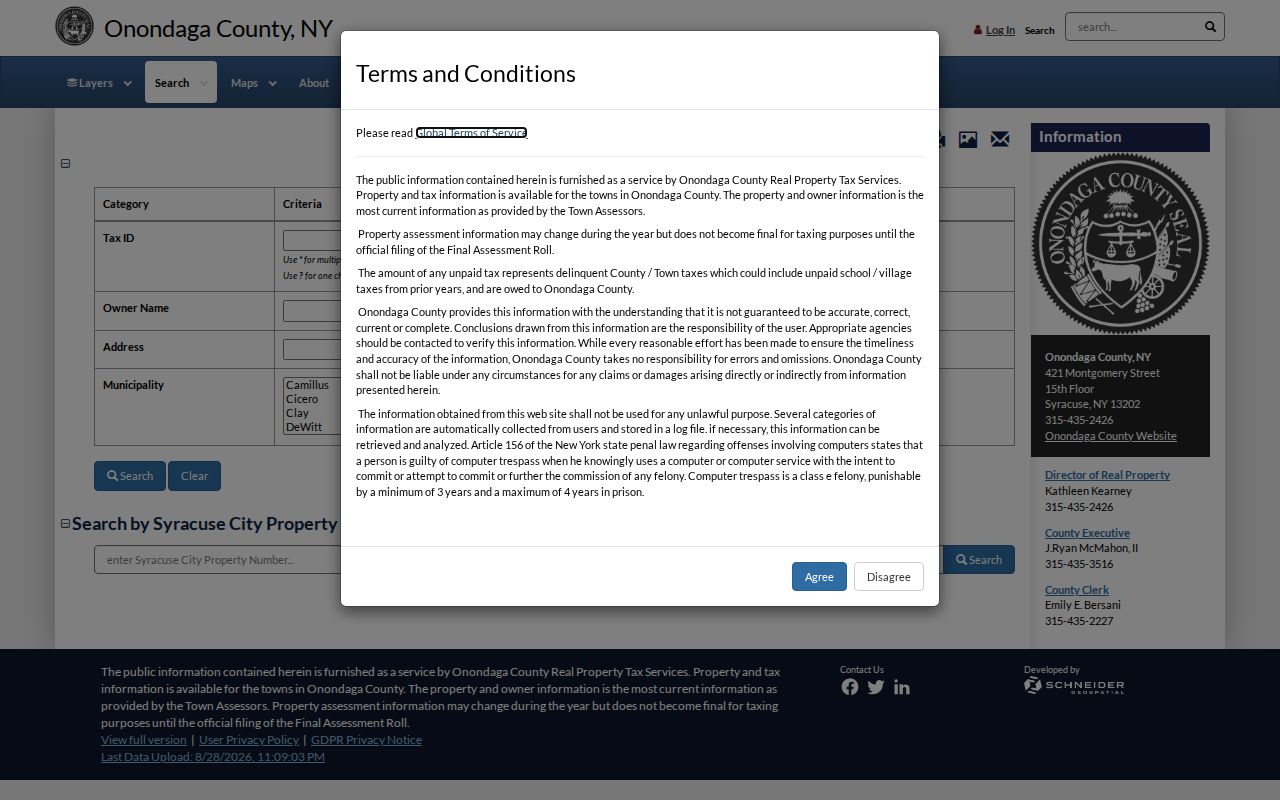
The image shows the public entry point only. It is not a completed Syracuse parcel card, so read it as a starting screen rather than live parcel results.
Separate Syracuse Street Address Roles
Five different Syracuse keys can all point to one property. The parcel ID, situs address, tax mailing address, deed legal description, and postal ZIP each matter in a street directory search. Each one plays a distinct part. The situs is the physical spot used for Syracuse map, permit, and code work. A tax mailing address is where notices go. It may belong to an agent, an organization, or a person living far from Syracuse. The legal description ties Syracuse title to lot, block, tract, subdivision, or map references. It can outlast a renamed street entirely.
- Parcel or tax-map ID
- An assessment identifier that helps connect the property record to map and title work.
- Situs address
- The physical location of the parcel or building, usually the useful key for a street search.
- Legal description
- The title language in a deed or mortgage that identifies land boundaries or a lot, block, tract, or map reference.
- Criss-cross directory
- A reverse directory arranged by address, if a library holds the volume for the needed year.
Keep each label clear in your source notes. A Syracuse mailing line can also reach beyond the city, since Onondaga County holds Syracuse, 19 towns, 15 villages, and the Onondaga Indian Reservation. Postal geography and Syracuse records jurisdiction do not always match.
Use GIS for Syracuse Street Geometry
County Planning maintains the GIS for Syracuse and for towns and villages across the county. The system pairs digital aerial photography with an interactive web viewer. To trace a Syracuse street segment, start with the target parcel. Note its boundary and parcel identifier. Then study the adjoining shapes. Hop back to Image Mate for Syracuse owner and tax detail. Neighboring Syracuse polygons show a spatial relationship, nothing more. They do not reveal a shared household or a list of people.
The Onondaga GIS viewer presents its parcel map and search fields on one screen. Layers and measurement and export tools sit alongside them. Layer names and identify-panel fields can shift as the county updates the map. So explore the viewer directly. Do not rely on any fixed control.
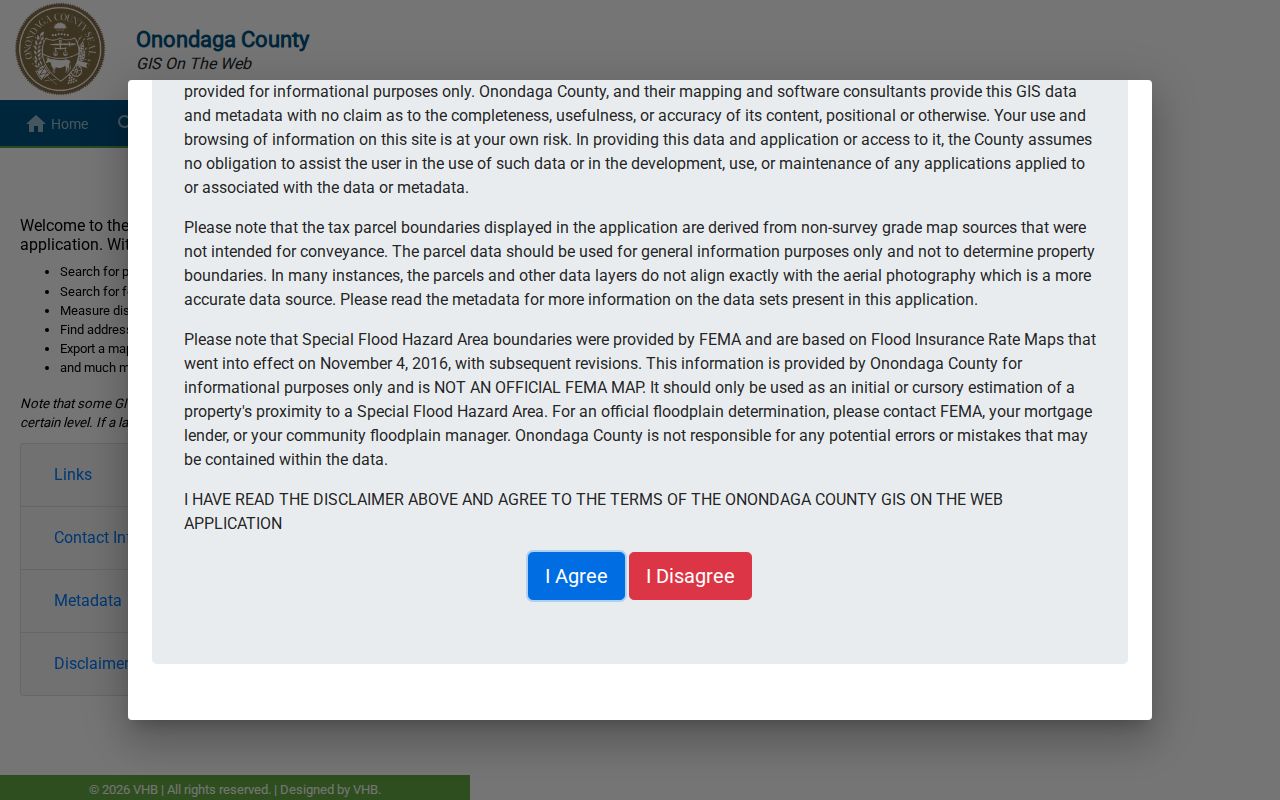
Use the Syracuse map for identification and geometry. Confirm owner, value, and mailing details through the assessor system, never by inference from what the map display shows.
Syracuse Street Directory Record Coverage
No single Syracuse source answers every street question. Each address-keyed record covers one slice of the picture. Together they can establish a parcel's identity, a recorded transfer, a dated city event, or a historic listed connection for the residents directory. The handoffs matter most. An owner is not an occupant, and a permit contact is not a resident, so let the record type decide what each Syracuse entry actually proves.
| Address record | Best key | People detail | Primary route |
|---|---|---|---|
| Image Mate parcel | Situs, parcel, owner | Recorded owner and a tax-mailing clue | Public portal and assessor verification |
| GIS parcel | Geometry and parcel ID | Parcel identity and adjacent parcels | County web viewer |
| Deed or mortgage | Legal description and parties | Grantors, grantees, mortgage parties, and dates | Cott index, clerk, or archive |
| Permit or code event | Address, parcel, application | Applicant or property-contact relationship | City database or FOIL |
| Voter record | Submitted identity and address | Registration result subject to law and protection | State lookup or election-purpose request |
| Historic directory | Street, number, and name | Dated listed occupant or household clue | OCPL, Clerk, NYSL, or FamilySearch |
City directories and census sources add the household layer over time. For deeper historical work, use the Syracuse Directory Book rather than assuming a current parcel record holds that past-resident history.
Trace a Syracuse Street Deed Chain
The Onondaga County Clerk holds Syracuse real-property records reaching back to 1794. Old paper does not equal a digitized image. Start with the current owner and legal description. Search that owner as grantee near the acquisition date. Read the grantor. Then run that seller as an earlier grantee to push the chain back. At every link, check the Syracuse lot, block, tract, map references, easements, and subdivision changes.
Cott eSearch offers free guest index viewing. Syracuse document images can sit behind an account, a subscription, or an image charge. Not every index entry has an image. Beyond the online index, the County Clerk counter and archives are the documented fallback. One quirk: before August 21, 2017, an older surname may carry an internal space. It appears Mc Carthy style. A Contains search on the second part recovers the entry.
The guest screen opens on a login form. Field labels, document choices, date controls, sorting, and result limits sit behind that login. So confirm those details live rather than guessing.
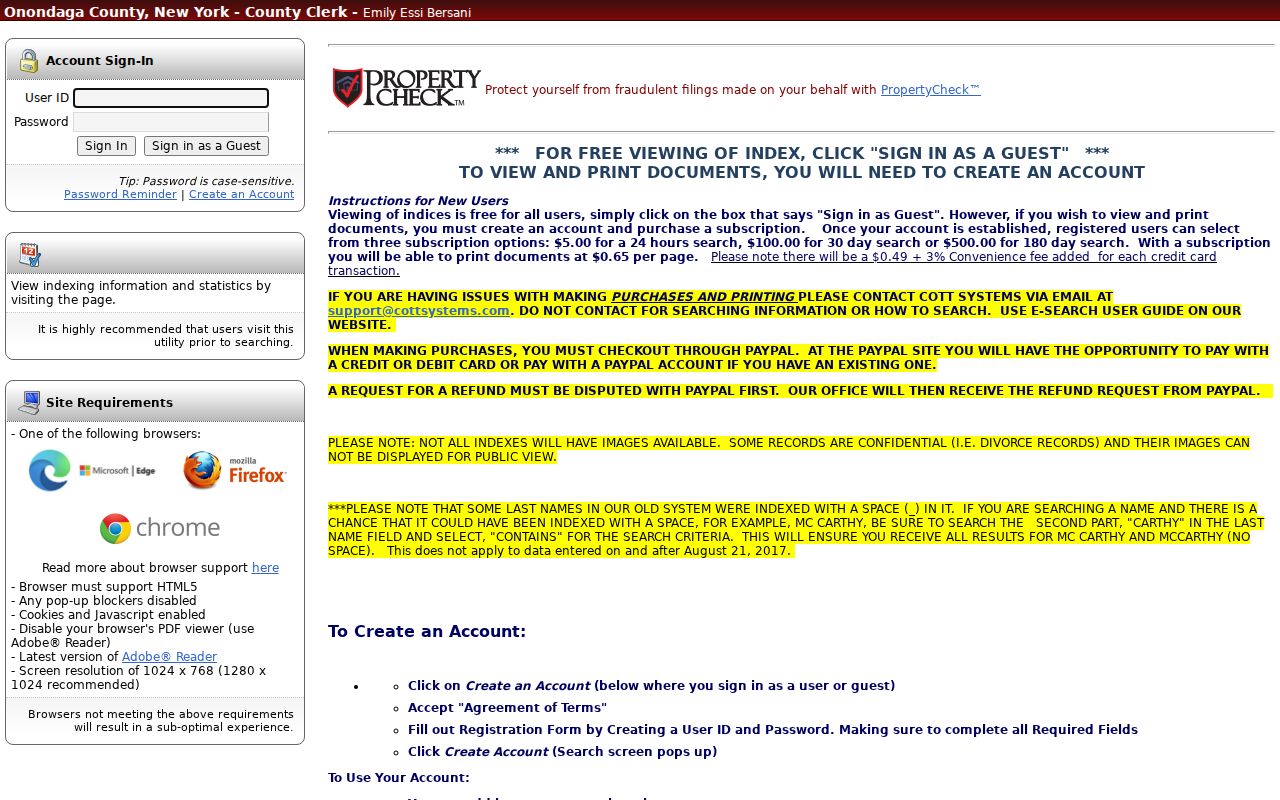
The image-access split is a practical warning. An index hit can steer the clerk request, while an image or certified copy comes through the appropriate custodian route.
Syracuse Street Permits and Code Events
Syracuse runs a self-service property and code database. It holds permits and code violations dating to 2011, plus mapping. A result ties an address or parcel to a dated permit, inspection, work type, status, or property contact. That contact is not proof of residency. Treat the listed Syracuse name as a lead. Confirm field details live, and do not assume a fixed template.
Does the portal lack the needed Syracuse city material? Send a focused request under the New York Freedom of Information Law. Syracuse routes FOIL through the Law Department. FOIL remains a fallback for agency records such as permits, code files, and board materials. It does not open sealed court files. Protected voter data and restricted vital records stay closed too.
Syracuse Street Voter Checks Have Limits
Start with one voter at a time. The New York Voter Lookup checks an individual Syracuse registration and poll site. Its inputs are last name, first name, date of birth in MM/DD/YYYY form, county, and ZIP code, with instructions referencing address information. It is not a public street-roster browser. A no-match can mean a spelling difference, a changed address, inactive status, or a protected record.
A full voter file follows a separate State Board of Elections FOIL process and requires a written elections-purpose statement under Election Law §3-103(5). Syracuse registration records open under supervision, but the protections are strict. Protected voter material stays withheld. So do Social Security and driver-license identifiers. Never stretch one check into a block list.
Syracuse Street Names Need Context
Older Syracuse address research needs two labels at once. Grab the historical name and a modern candidate. A local 1887 Syracuse account lists changes including First North to Erie, Second North to Herkimer, Canal to Harbor, Exchange to Williams, and Hemlock to West Fayette. The account lists no ordinance or date. Treat it as a search aid. Then confirm the physical connection with a legal description, map block, lot, or adjacent street.
Jurisdiction can shift too. The Town of Geddes says its village was annexed to Syracuse on May 20, 1886. An old address might sit in Geddes first. Check village or town context before later Syracuse city records apply. This is a geographic handoff, not proof that every address was renumbered on that date.
Syracuse Streets Before Modern Parcels
Some questions start before any modern parcel trail exists. The 1852 Onondaga landownership map is a useful bridge. Its Library of Congress metadata says it shows buildings and occupant names. The Syracuse map carries wards and block numbers. That kind of source puts a named person on a block, but it remains a dated historical observation rather than a current address record.
Onondaga County records also reflect shifting Syracuse places. Syracuse incorporated in 1848, after the canal era reshaped the settlement. Early material may use village, ward, canal, or salt-works language instead of a modern address. Record both Syracuse forms in your source note. Only then declare a street match.
Document a Syracuse Street Directory Match
Keep five facts. Record the source, date, address form, person name, and exact role. Write "recorded Syracuse owner," "tax-mail recipient," "grantee," "directory listing," "voter registration result," or "permit contact," not a blanket "resident." A middle initial or a name variant helps. So does the Syracuse legal description when surnames match.
Note: The County's 2025–2030 capital plan flags remaining mortgage and numerical deed-index digitization, so an older record may exist while its online image remains incomplete.
Limits of Syracuse Street Records
Syracuse parcel records tell you who owns land, not who lives on it. A street roll built from public address data can miss people entirely. Old directories lag the year you want. They may list a business address instead of a home, or skip a household altogether. Some limits come from law. The federal Driver's Privacy Protection Act bars release of DMV personal information. Utility customer lists, delivery routes, and private association rosters sit outside public Syracuse government street rolls. Private data stays private as well.
Voter records can be protected. The New York Address Confidentiality Program also shields certain addresses from ordinary disclosure. A substitute address proves nothing about where someone actually lives. Spotted an error? Take it up with the custodian of that record, because a general records request will not fix it.
Lawful use. Use Syracuse address records for a personal, lawful purpose such as family history, property curiosity, civic research, or a safety plan. New York Penal Law §§120.45, 120.50, and 240.30 address stalking and aggravated harassment; never use records to track, threaten, or intimidate a person.