
Find Syracuse Residents by Clue
Syracuse does not maintain one public household roll. The useful Syracuse residents directory trail is divided among Onondaga County property data, the state voter service, County Clerk indexes, city records, courts, and historical collections. Begin with an address when the goal is a parcel or a dated property connection. Begin with a full name plus a date, city, or known address when you need to distinguish people with similar names. Treat every result as a record of a specific role, such as owner, voter, deed party, court party, or directory listing, rather than proof of every person connected with an address.
For a recent question, compare two independent sources before drawing a conclusion. For an older question, move from the address to a directory, census, obituary, map, or deed. When a record is not online, the next step is usually a targeted request to the custodian, the County Clerk archive, or the library, not a guess based on a partial result.
- Check Image Mate by one owner, address, or parcel detail.
- Use the state voter form only for an individual registration or poll-site check.
- Search the County Clerk index for a deed, mortgage, judgment, or business connection.
- Use OCPL directories, telephone books, census film, and obituary tools for earlier years.
- Ask the correct office, archive, or library for material outside the public index.
Syracuse Residents Record Offices
Several Syracuse residents records offices answer different pieces of the same question. The County Clerk records land instruments and selected court and business material. Real Property Tax Services supplies the assessment and tax route. The Board of Elections handles local registration questions while the state provides the individual voter form. City departments retain permits and code files, and OCPL keeps the historical name-and-address layer. For a full address chain, the Syracuse street directory explains how those sources connect without treating any one of them as a household census.
Onondaga County Clerk
401 Montgomery Street, Room 200
Syracuse, NY 13202
315-435-2227
Real Property Tax Services
Onondaga County assessment route
Syracuse parcels use local assessor data
Verify with the appropriate agency
Onondaga Board of Elections
1000 Erie Boulevard West
Syracuse, NY 13204
315-435-8683
Syracuse Residents in Image Mate
Image Mate Online is the practical first stop when a Syracuse question begins with a parcel, recorded owner, or tax mailing detail. Onondaga County describes the service as a route to assessment and property-tax information, tax maps, photographs, and current tax bills. Search with one item first, then narrow only if the result set is broad. The documented search paths are owner name, property or situs address, parcel or tax-map identifier, municipality, and ZIP. The live public screen did not expose every exact label, so the right approach is to use the available form rather than assume an unverified filter.
| Image Mate item | Use in Syracuse research | Important limit |
|---|---|---|
| Owner name | Find a property record by a recorded owner name. | Name variants can matter. |
| Situs address | Identify the physical parcel and city location. | It can differ from the tax mailing address. |
| Parcel or tax-map ID | Carry the most exact property key into map and deed research. | The research did not document a universal ID format. |
| ZIP or municipality | Narrow a broad search after the first item. | Postal geography does not establish city limits. |
The county cautions that assessor-supplied data can change during the year and is not guaranteed complete, current, or correct. A property card is strong evidence of a property or tax relationship, but not a complete list of people at a location.
Start with the Image Mate public-access page before opening the screenshot below. It shows the entry point and its public-access route, not a live Syracuse parcel card.
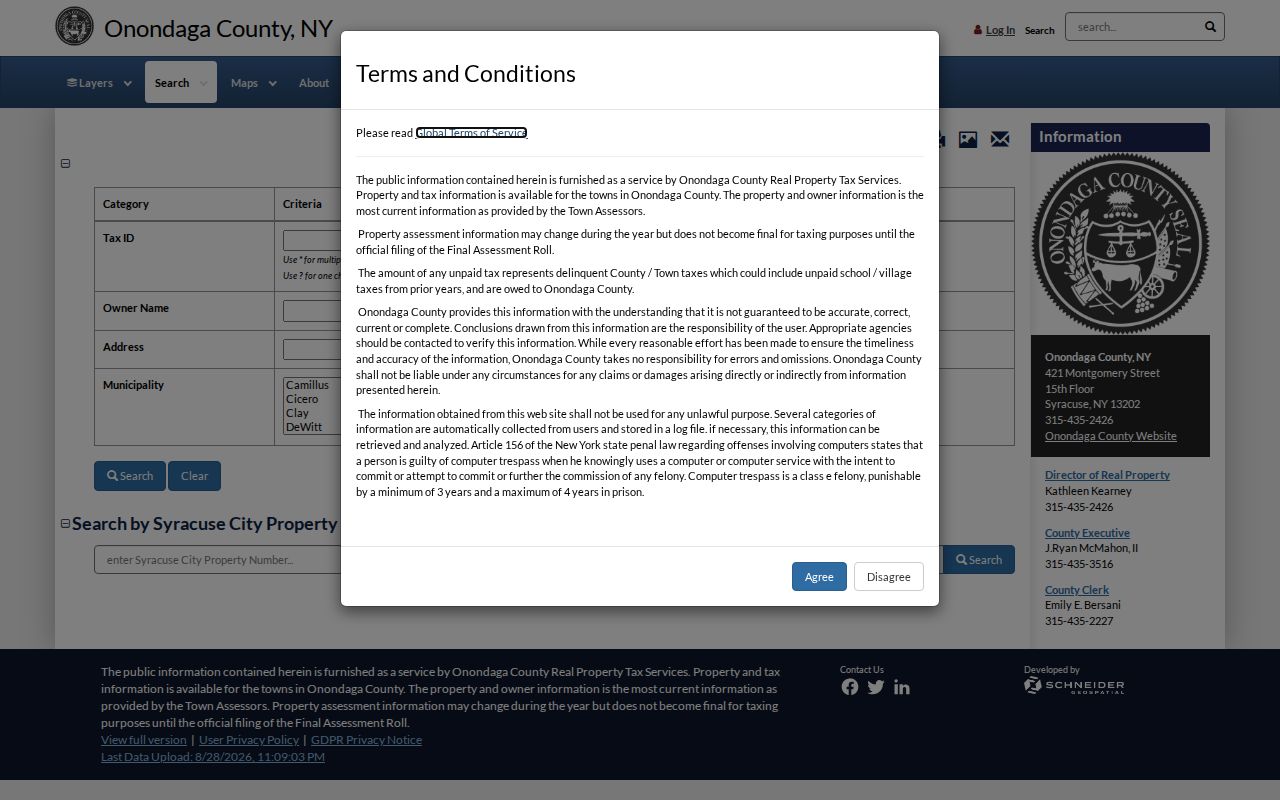
Use the image as a reminder to keep the query simple, then verify an important result with Real Property Tax Services or the municipal assessor.
Syracuse Residents Through Deed Indexes
The Cott eSearch gateway gives a free guest view of the Onondaga County Clerk index. The underlying county land records begin in 1794, yet the research does not establish a complete online image cutoff. Guest access is useful for finding an instrument and its parties; images and printing may require an account, a subscription, or payment, and some confidential images are blocked. The clerk counter, archive, microfilm holdings, and copy services remain part of the access chain.
A name in the index is a dated legal role. A grantee may lead to a purchase, a grantor may lead backward, and a legal description can keep a property trail intact when a street number changes. Older Cott data can place a space inside a surname, such as a split form of a name before August 21, 2017. When a conventional name search fails, the documented workaround is a Contains search on the second part of that surname. Preserve the spelling you found in the source note.
Open the County deed-index entry page before using this image. It captures the guest-login stage and account options, not an assumed post-login result screen.
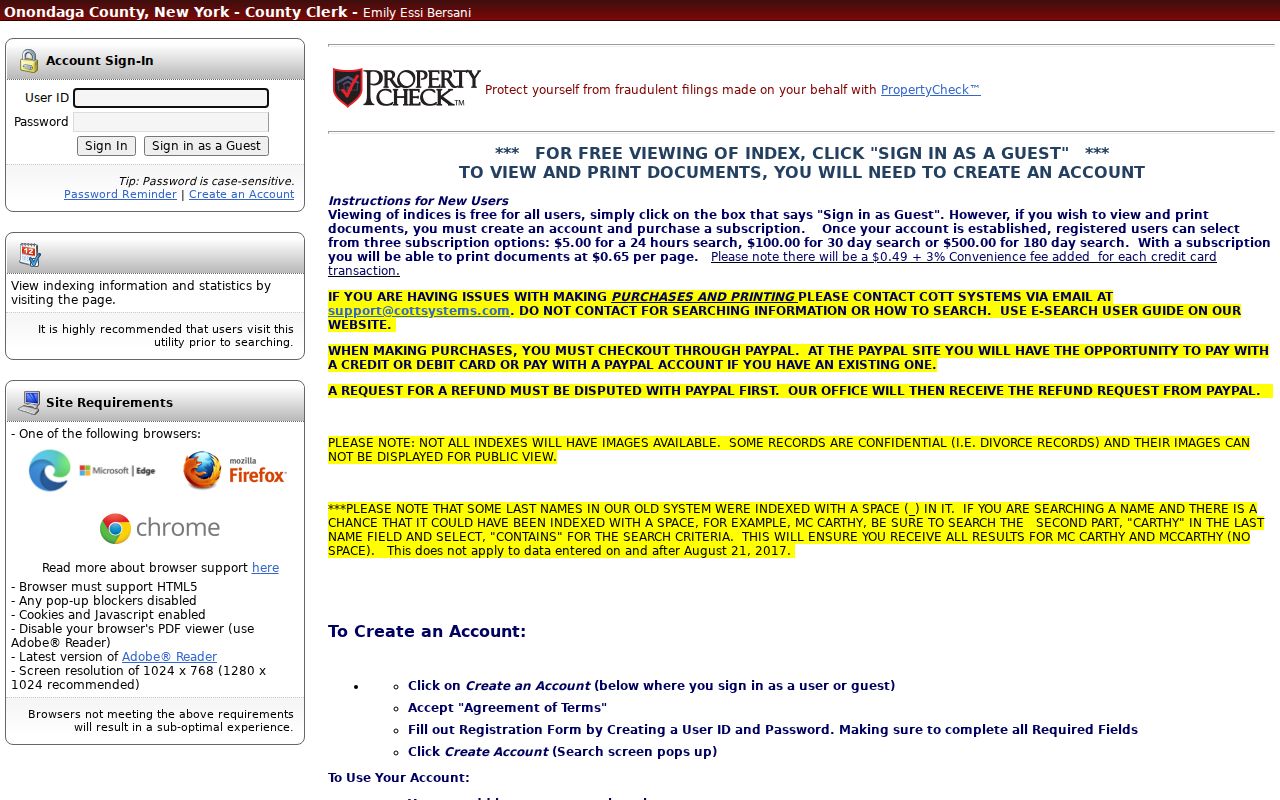
That online-to-counter boundary matters because the county is continuing digitization of mortgages from 1794 to 1950 and numerical deed and mortgage indexes from 1799 to 1986.
Syracuse Voter Records With Limits
The New York Voter Lookup is designed for a submitted voter, not for browsing a street or compiling a bulk directory. Its visible form asks for last name, first name, date of birth in MM/DD/YYYY form, county, and ZIP information. A match can help confirm a registration or poll-site question. A no-match can reflect a spelling difference, changed address, inactive or protected status, or another person with the same name. It should never be treated as proof that nobody is connected with an address.
New York Election Law makes registration records open under supervision while protecting sensitive identifiers and confidential participants. A full voter-file request goes through the State Board of Elections and must state an elections purpose under Election Law §3-103(5). The local Onondaga Board of Elections can answer registration and polling questions, while historic poll-book questions belong with the county office, archives, or library. Those channels are different by design.
See the state voter form shown here for the combination of name, birth-date, county, and ZIP inputs.
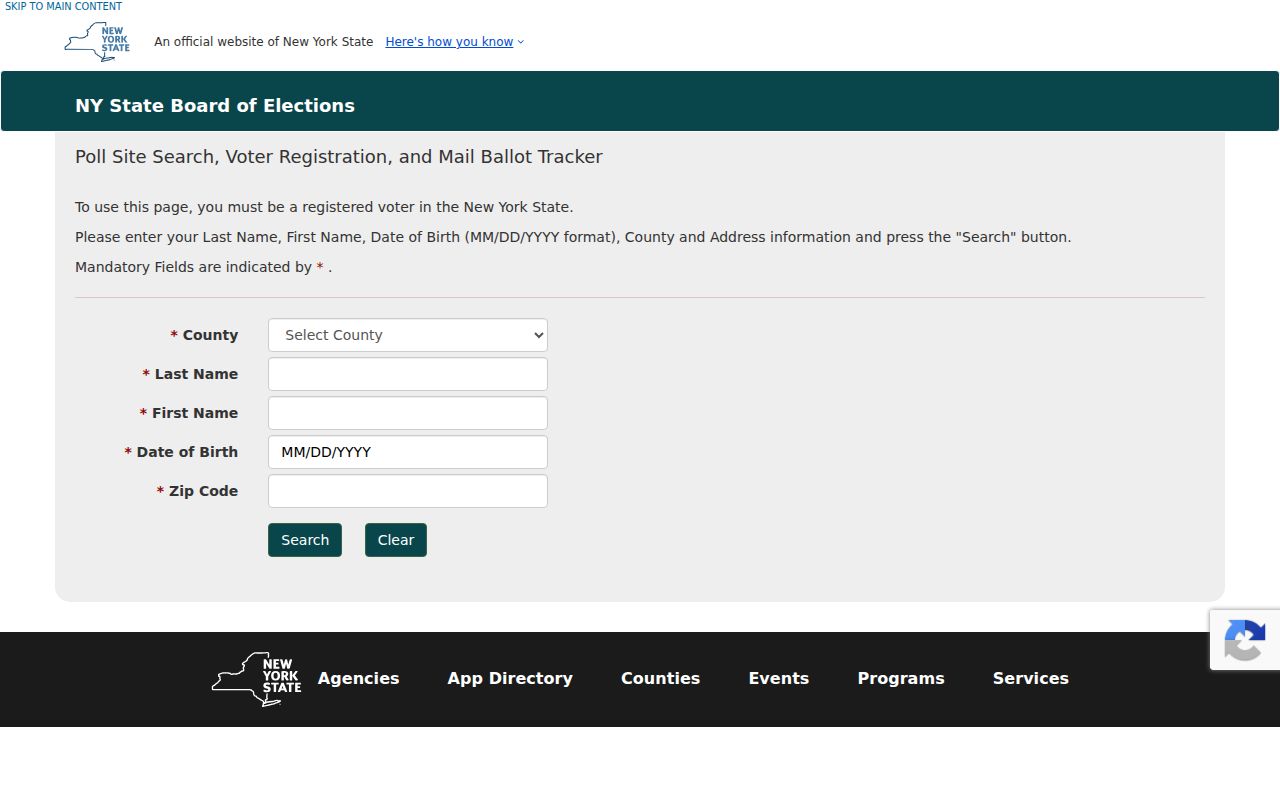
Use those fields to check an individual registration record only, then keep its date and source separate from any property or directory evidence.
Current Syracuse Residents Directory Sources
A current Syracuse residents directory search works best when the source matches the question. Image Mate is a property and assessment route. The voter service is a one-person registration check. Cott is an index of deed, mortgage, and related legal parties. Courts, licenses, and agency records each have their own boundaries. None is a whole-city list of everyone at an address. The table below identifies the record role and the real access channel so a search can move from a screen to the proper office when needed.
| Source | Who It Lists | Keeper | Access |
|---|---|---|---|
| Image Mate property data | Recorded owners and parcel/tax details | RPTS and local assessors | Public portal, then agency verification |
| State voter lookup | One submitted registration and poll-site check | New York and county elections offices | Public individual form; protected records remain closed |
| Cott deed index | Parties to land instruments and legal descriptions | Onondaga County Clerk | Guest index; images may be paid or at counter |
| City permit and code records | Property contacts and dated work or compliance events | Syracuse departments | Self-service from stated 2011 data; FOIL fallback |
| Public civic sources | Named people in a public role or dated meeting | City and civic organizations | Contacts and public minutes, not member rolls |
Use the Syracuse resident lookup when a name has to be checked across sources rather than when the task is to survey a street or map a block. The difference keeps a property owner, a voter, and a historical directory listing from being blended into one unsupported identity.
Syracuse Residents in Court and Vital Routes
When the question is about a case, estate, or documented life event, use the specialist route rather than trying to force it through a property search. New York Courts eCourts separates WebCivil Local, WebCivil Supreme, WebCriminal, WebFamily, and WebSurrogate. An index or calendar result can identify a case reference, but the court clerk holds the actual file and some categories are sealed or confidential. Onondaga Surrogate's Court is the local probate route for estates and related matters.
Vital records also have a separate custody and eligibility system. Syracuse City Clerk copies are limited to licenses issued there. Onondaga Vital Statistics handles local birth and death routes, while the state Department of Health and State Archives have statewide certificate and historical-index roles. Genealogy release guidance generally uses periods of more than 75 years for births and more than 50 years for deaths and marriages, subject to the stated conditions and direct-line exceptions. An index is a lead, not a certificate.
Syracuse Residents and Records Requests
When the source is a city permit, code file, board record, or another agency document that is not posted, the fallback is the New York Freedom of Information Law. The official guidance calls it FOIL, Public Officers Law Article 6, §§84–90. Agencies generally must grant, deny, or acknowledge a written request within five business days. An acknowledgement normally gives a reasonable approximate date, and the agency must explain a longer delay. Appeals are generally due within 30 days, with an agency appeal response due within 10 business days.
For Syracuse city material, the research identifies the Law Department FOIL route at FOIL@syr.gov and 233 E. Washington Street, Suite 300. FOIL cannot open sealed court files, restricted vital records, confidential voter information, or other protected data. A focused request that names the address, record type, date range, and agency is more useful than a request for a general person dossier.
Open the Syracuse FOIL page before using this image. Its material describes the city instructions and notes the self-service property and code database.
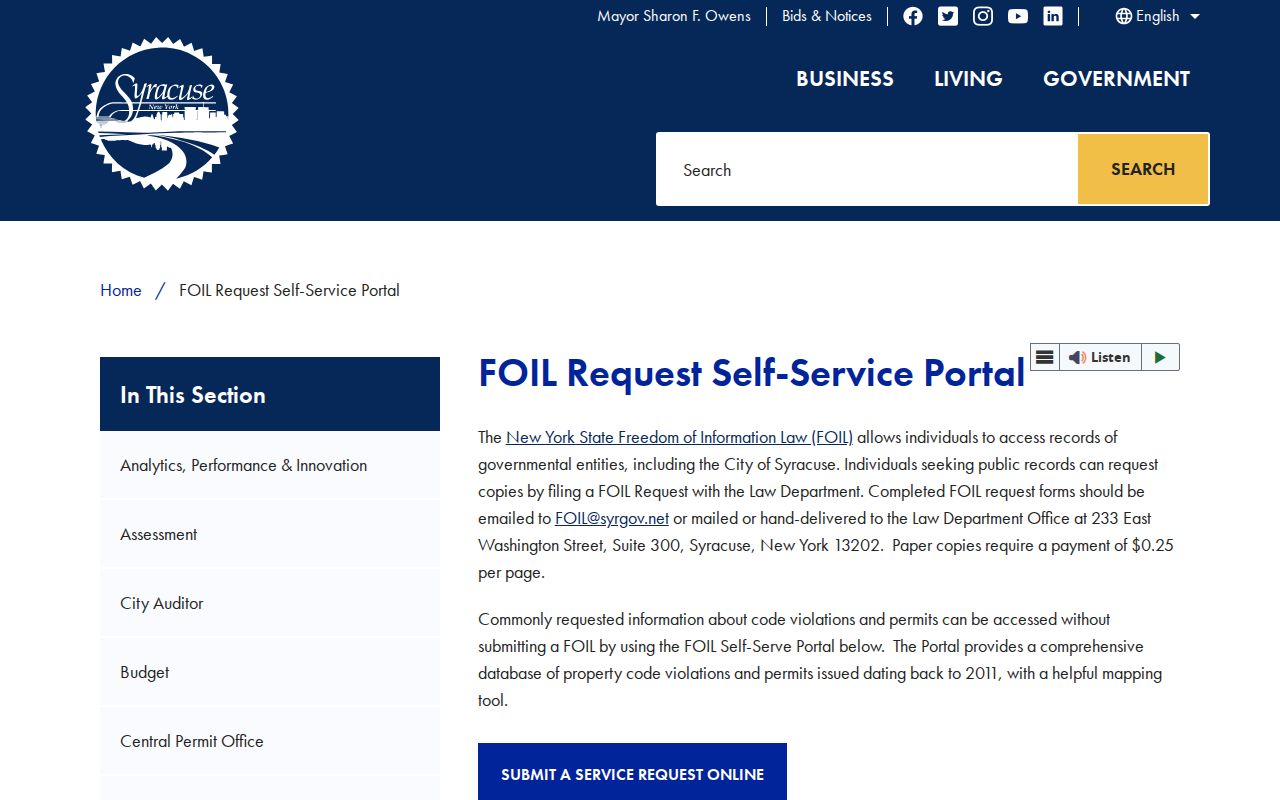
The image connects the online city record route with the written-request channel when a historic or missing file needs custodian review.
Syracuse Residents and Custody Sources
Custody information is not a substitute for a resident directory. The Onondaga County Sheriff lookup is a current Justice Center route, but the research did not capture its exact live fields or result layout. State custody belongs with New York DOCCS, which searches by DIN, NYSID, or name and has limited former-record coverage. Federal custody uses the Bureau of Prisons locator. Each service answers a different status question and may omit protected or removed material.
The public New York registry likewise has its own limits: it accepts one primary mode at a time, such as surname, county, or ZIP, and covers only the state-defined public levels. Do not use a search result to make a conclusion beyond the custodian's displayed data. Court indexes, clerks, and formal records remain the verification route for a case-specific question.
The Sheriff lookup landing page is shown below. The capture did not expose an assumed inmate result, so it is presented only as the official access point.
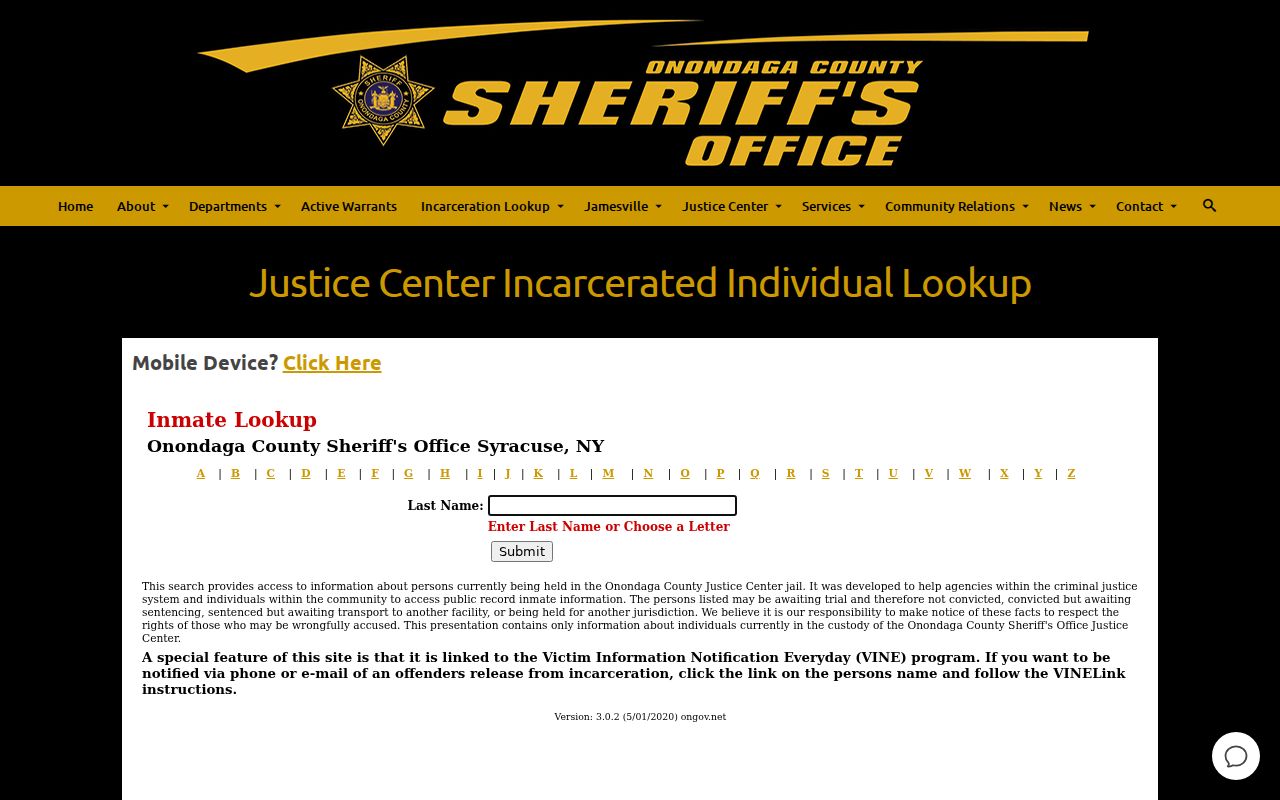
Keep a custody search date with the result and use a court or agency record for the narrower question it raises.
Historical Syracuse Residents Directory Trails
The historical Syracuse residents directory shelf is strongest at OCPL Local History & Genealogy. Its reported run includes some microfiche from 1844 to 1862, microfilm from 1862 to 1935, and print from 1936 forward, with some missing years. The County Clerk Archives lists directories from 1861 forward. The State Library provides another on-site, non-circulating bridge with selected early fiche and film through 1935. OCPL also says directories through 1923 were digitized at FamilySearch, although an exact Syracuse scan link and publisher-by-year list were not verified in the research.
A directory entry gives a dated printed listing, not a timeless statement of residence. Pair it with a census, obituary, deed, map, telephone book, or probate record. Ask the library staff for a reverse or criss-cross volume when the starting fact is an address, since the research did not verify a universal Syracuse reverse-directory run. The full collection and reading method belong on the Syracuse city directory page.
Syracuse Residents Archive Bridges
Historical work in Syracuse often needs more than a directory. OCPL has an obituary index covering about 1860 to 1996, newspaper microfilm from 1850 to near the present with early gaps, cemetery cards, family files, WPA material, and New York State census microfilm for 1855 to 1925. The 1852 Onondaga landownership map is a rare bridge because its Library of Congress description identifies buildings and occupant names and includes Syracuse wards and block numbers. Sanborn volumes add building context, not a name or title conclusion.
Record terms. A roll is a list maintained for one purpose. An index points to a record. A parcel is a mapped property unit. A criss-cross directory, when one is available, reverses the usual name-first directory and begins with an address.
These sources help with family history, a reunion trail, or a dated house study because they preserve context that a modern portal may not show. They do not remove the need to label the date, source, and role for every name.
Syracuse Residents Search Stop Signs
A responsible Syracuse residents directory search has clear stopping points. The State Address Confidentiality Program protects eligible participants with a substitute address, and that substitute is not evidence of a physical location. DMV personal information is restricted by federal law. Court files can be sealed, and vital records have their own eligibility rules. New York voter rules protect identifiers and confidential participants. No public index turns those limits into an invitation to infer hidden facts.
A commercial people-finder category can collect stale public filings, old directories, marketing information, and records that merge people with the same name. It may charge for access and an opt-out affects only that display, not the official custodian record. Official sources are usually slower but let a reader identify the agency, date, record role, and access limit. Use the person-to-person information only for lawful personal research, family history, civic context, or a legitimate safety concern. Never use it to stalk, harass, track, or intimidate someone.
For the state-defined public registry route, start at the New York public subdirectory. The form has one primary search mode at a time and a captcha, rather than a general household search.
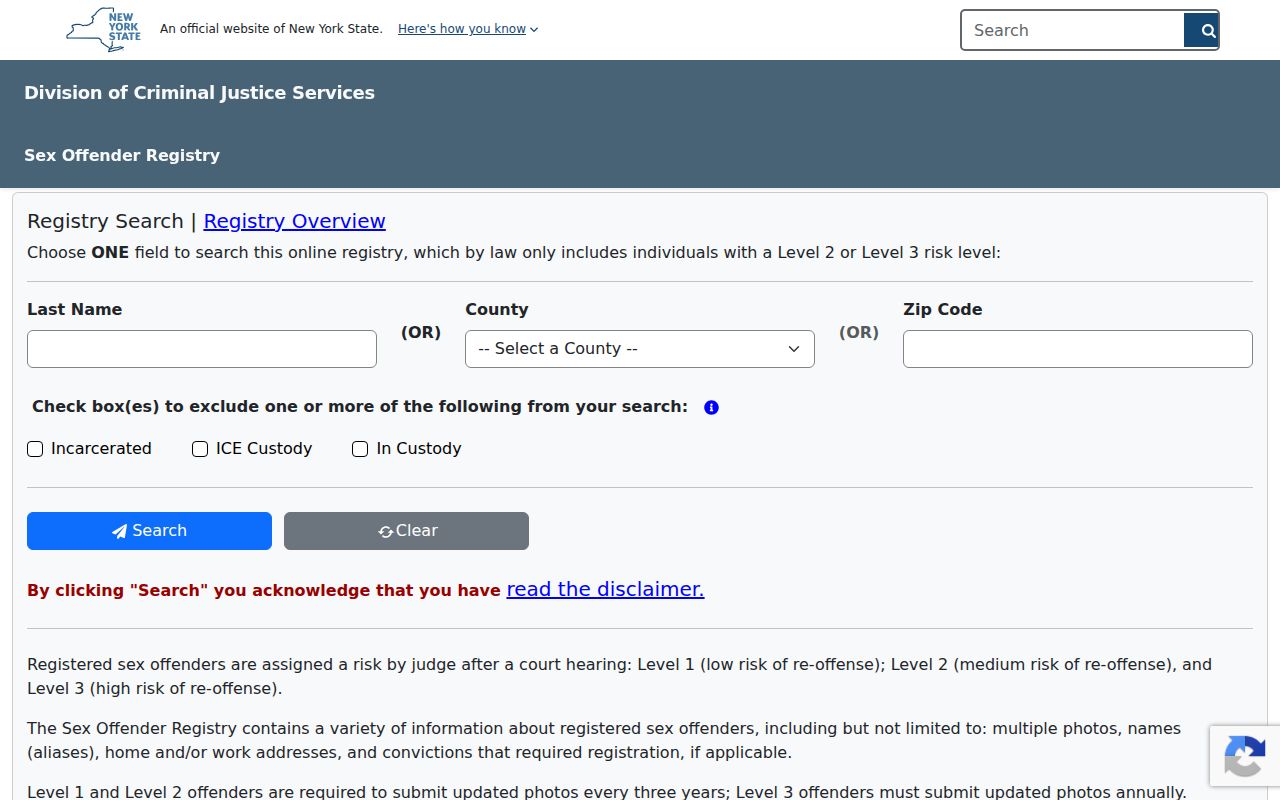
The screenshot reinforces the point that a registry search is a limited official tool with its own search choices and legal-use rules, not a broad resident record.