
Syracuse Previous Residents by Era
For a Syracuse address, the most useful question is who was connected to it in a specific record on a specific date. The County Clerk's land records supply the ownership and legal-description layer. Directories and telephone books preserve listed names and addresses. Census schedules show a household on their own dates. Maps show the structure or block, while permits and code files record dated events. No one of these sources represents every person ever present, so a careful trail gives each name its record role: owner, grantee, grantor, directory listing, census household member, permit contact, obituary relative, or estate party.
| Address source | Local years reported | Access route | What it can establish |
|---|---|---|---|
| County Clerk land records | County records from 1794; digitization targets mortgages 1794-1950 and numerical indexes 1799-1986 | Cott, Clerk counter, or Archives | Title parties and legal descriptions; online image coverage is not stated as complete. |
| OCPL directories | 1844-1862 fiche; 1862-1935 film; 1936-present print, with gaps | OCPL Local History & Genealogy | Dated city or suburban listing and address clues. |
| NY State Library directories | Selected 1844 and 1851-1860 fiche; 1861-1935 film | New York State Library | On-site, non-circulating duplicate or bridge copies. |
| Federal and state census | Federal through 1950; New York State 1855-1925 | Library, archives, and authorized census access | Household snapshot for the census date; the 1890 federal census is largely lost. |
| Sanborn and landownership maps | Syracuse 1892 and 1953 confirmed; 1852 landownership map | Library of Congress | Structure, block, building use, or named map occupant, not title proof. |
Start with the source nearest the date you need. A recent title question usually begins with the parcel and deed chain. A family question from the directory era may start with OCPL and then return to the deed or census record for a check. This keeps each name tied to evidence rather than memory or an undated list.
Define Syracuse Address Keys
Before chasing a name, write down the situs address, parcel or tax-map identifier, legal description, and municipality. The situs is the physical location. A tax mailing address may point elsewhere and is not proof that the recipient was at the site. A legal description uses the recorded lot, block, tract, or other parcel wording. It often survives a street rename, renumbering, or subdivision better than a house number alone. Syracuse is the county seat, but Onondaga County records cover the city as well as towns and villages, so the municipal label is part of the address definition.
Build a simple timeline with one row for each dated item: current parcel card, current deed, earlier deed, directory entry, census household, permit or code event, obituary, and probate endpoint. Keep the exact wording and any uncertainty. If the legal description changes between deeds, use the plat, subdivision, or map reference before deciding that the trail remains on the same parcel.
Trace Syracuse Deed Chains
The backward deed method starts from the current owner and works from one recorded transfer to the prior one. In a current deed, the grantee is the person or entity receiving the interest, while the grantor conveys it. Search the recorded seller as a grantee to locate that seller's earlier acquisition, then repeat. At every step, compare the legal description, date, instrument reference, and cross-reference. A deed can transfer real property, and a mortgage identifies parties, amount, address, and legal description, but neither document alone proves who occupied the location on every date.
- Use the current parcel record to preserve the situs, parcel identifier, municipal label, and legal description.
- Find the current acquisition deed and record the grantee, grantor, recording date, instrument reference, and parcel wording.
- Search that grantor as a prior grantee, then compare the earlier deed's legal description with the newer one.
- Repeat backward, using a plat or map cross-reference when a street number changes or a subdivision appears.
- Move to the Clerk counter, Archives, microfilm, or a paid search or copy route if the online index or image does not reach the needed instrument.
- Grantor
- The party who transfers an interest in a deed.
- Grantee
- The party receiving that interest through the recorded instrument.
- Chain of title
- The sequence of recorded transfers that connects a parcel backward through time.
- Legal description
- The recorded parcel wording that can reconnect the trail when an address label shifts.
The image below is from the Onondaga County Cott eSearch guest-login route, the documented online starting point for free index viewing.
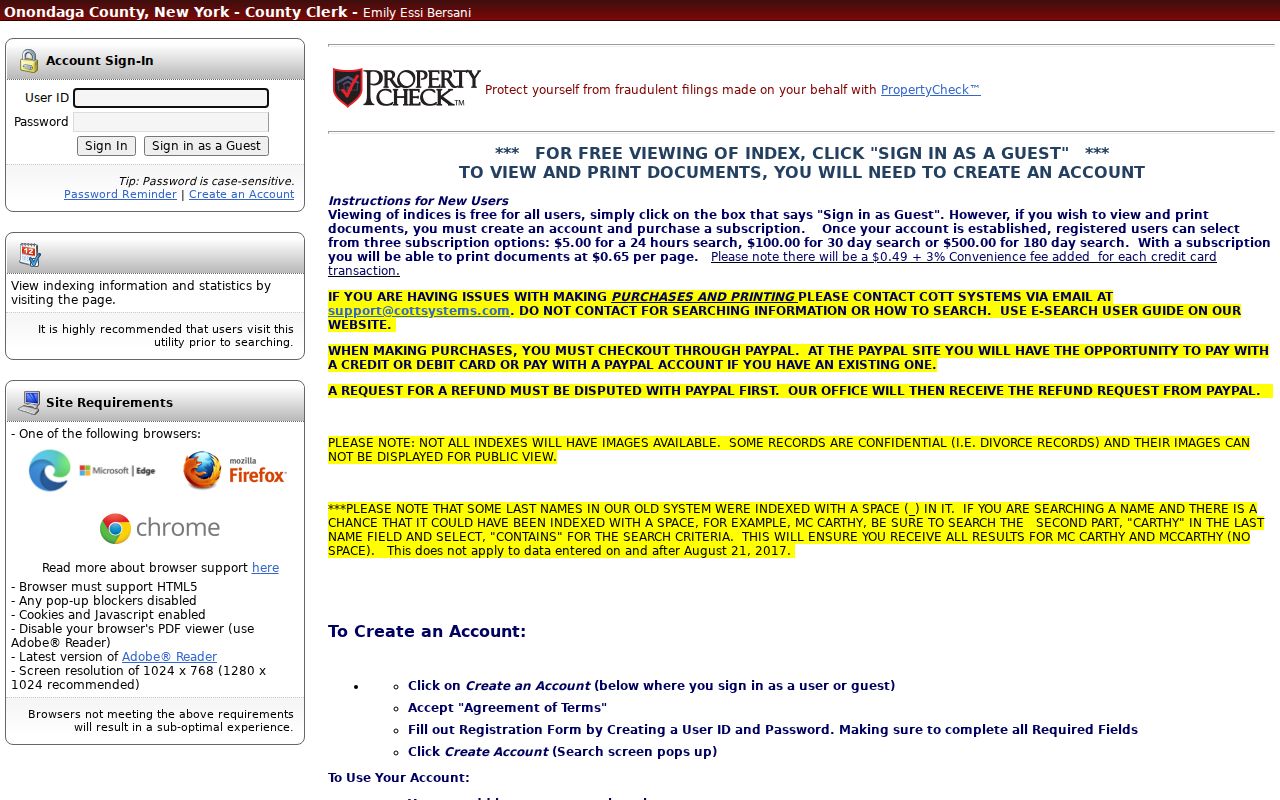
Cott's exact guest search fields were not exposed in the research capture. The available route confirms guest index viewing, account options, and a separate image and printing arrangement, so record the search terms and results instead of assuming a field or image appears for every instrument.
Syracuse Records Beyond Cott
The online route is only one access channel. Cott offers free guest index viewing, while its listed image subscriptions are $5 for 24 hours, $100 for 30 days, and $500 for 180 days. Images print at $0.65 per page, with listed card and PayPal charges. Not every index has images, and confidential material can be blocked. The research did not capture the exact guest search controls or a complete online cutoff, so an empty web result should not be treated as proof that an instrument does not exist.
The Onondaga County Clerk's mortgages and deeds information states that county records date from 1794. The county's 2025-2030 capital plan targets remaining mortgages from 1794 through 1950 and numerical deed and mortgage indexes from 1799 through 1986 for digitization. Earlier or unindexed material may require the County Clerk archival or microfilm route, the photostat and archival records line at 315-435-2237, the real-property line at 315-435-8250, or a paid search or copy request. The difference between a 1794 record history and online visibility is a central Syracuse research limit.
Syracuse Previous Residents in Census
Ownership is only one part of the address story. To study past residents, ask OCPL staff whether a reverse, criss-cross, address, or suburban directory exists for the year, then search the alphabetical directory for spelling variants. OCPL reports city and suburban directories from 1844 to the present in changing formats, with missing-year caveats. County Clerk Archives lists directories from 1861 to the present, and the New York State Library holds selected fiche and film. FamilySearch digitization reaches through 1923 according to OCPL, but the exact Syracuse volume links and page images remain unverified.
- Match the address to the closest available directory edition and copy the street form exactly.
- Search each listed surname in the alphabetical section and record any address, relationship, or business cross-reference.
- Pair the directory date with the nearest federal census or the 1855-1925 New York State census microfilm.
- Preserve both observations when they disagree, since a move may have occurred between the directory compilation and census date.
- Use the obituary index, newspaper files, or probate record to investigate a departure, death, heir, or estate connection.
The OCPL Local History & Genealogy collection also holds telephone directories, cemetery cards, WPA files, newspaper clippings, family vertical files, and state census microfilm. Those sources can provide a former address or kinship clue without turning a directory listing into a claim about every past resident.
Syracuse Maps Need Corroboration
Maps are valuable for placing a building in time, but they are not proof that a named person owned or occupied it. The 1852 Onondaga landownership map at the Library of Congress identifies buildings and occupants and includes Syracuse wards and block numbers. It is a rare bridge when the directory or deed trail begins too late. Syracuse's confirmed 1892 Sanborn volume has 78 sheets, and the confirmed 1953 volume has 59 sheets. Sanborn sheets can show a footprint, building material or use, and street context. The later volume also includes portions of Solvay, Camillus, DeWitt, and Geddes, so a Syracuse map title does not by itself establish the municipality.
Use map evidence to compare a block, lot, street name, or structure with the next deed or directory. Then state the limited conclusion plainly: the map supports location or building context, while the dated title, directory, census, or permit record supplies the particular role.
Syracuse Archive House History
The County Clerk Archives offers a local house-history sequence rather than a one-step answer: directories for earlier owners or businesses, tract maps and early builders, business certificates, deeds, industries and people, wealth records, and historical aerial images including 1938. This sequence is useful because it moves from a visible structure and address toward parcel identity and title evidence. The archive reports records from 1794 to the present and preserves maps and historical records alongside directories, census material, naturalization records, military material, and related files.
The image below comes from the Onondaga County Clerk Archives, the source for the local archive holdings and house-history sequence.
Use the archive, library, and parcel records together. If a result is unavailable online, the archive or counter can be the appropriate fallback rather than a reason to infer a missing name.
Syracuse Old Street Names
Address continuity is a local geography problem. A Syracuse historical account lists 1887 changes that include First North to Erie, First South to Cayuga, Canal to Harbor, Exchange to Williams, and Hemlock to West Fayette. The research did not locate the definitive municipal ordinance or a final source for every rename, so preserve both the old label and the modern candidate. Compare them with the legal description, map block, cross-reference, or an adjacent street before joining records.
Geddes adds another jurisdiction check. The Town of Geddes reports that its village was annexed to the City of Syracuse on May 20, 1886. An earlier address may therefore lead to Geddes, village, or town records before it falls into the city context. Annexation does not prove that a number changed on that date, but it tells the researcher where to look next.
Syracuse Previous Residents Role Labels
When a trail reaches a name, label the result before drawing a conclusion. A deed grantee received an interest. A grantor transferred one. A directory named a listed person for that edition. A census documented a household on its enumeration date. A permit or code file can identify an applicant, owner, contact, or event, yet it does not prove residence. An obituary can identify relatives or a last known address, and probate can identify heirs, fiduciaries, or estate property. Keeping those distinctions prevents the previous-residents search from merging different people and dates into one story.
Lawful personal use. Use historical address research for family history, heir questions, civic curiosity, personal safety, and understanding a Syracuse place over time. Do not use records to stalk, harass, or harm a living person.
For the historical directory shelf itself, the Syracuse City Directory collection provides the fuller format and access detail. Here, the useful finish is a source note with the date, exact address form, record role, repository, and any remaining uncertainty.