
Syracuse City Directory Holdings
Onondaga County Public Library, usually called OCPL, has the broadest public shelf for these Syracuse volumes. Its Local History & Genealogy description reports earlier material on fiche from 1844 to 1862, microfilm from 1862 to 1935, and print from 1936 to the present. Some years are missing. The overlap at 1862 is a practical reason to ask for the catalog entry or reel rather than assume one format. The County Clerk Archives lists Syracuse directories from 1861 onward, while the New York State Library provides an important second on-site run. No accessible source identifies one publisher for every Syracuse year, so a title page remains the right source for that detail.
| Directory collection | Years reported | Holding point | How to use it |
|---|---|---|---|
| Syracuse and suburban directories | 1844-1862 fiche; 1862-1935 film; 1936-present print, with gaps | OCPL Local History & Genealogy | Use the reader or print volumes and ask staff about a missing year. |
| County Clerk directory holdings | 1861-present listed | Onondaga County Clerk Archives | Confirm the format and the particular year through the archive. |
| Syracuse directory duplicates | Selected 1844 and 1851-1860 fiche; 1861-1935 film | New York State Library | Non-circulating, on-site material. |
| Digitized Syracuse volumes | Through 1923, according to OCPL | FamilySearch Catalog | Locate the volume first, then verify the title page and scan. |
The OCPL Local History & Genealogy collection is the source for the local format ranges and the missing-year caution. Start with the year nearest the known address, then widen the search only after recording what that edition actually calls the street and the person.
Syracuse Directory Years in Context
Syracuse directories belong to a larger sequence of local record keeping. A Syracuse University Press excerpt identifies a directory on file at the Syracuse Public Library in 1851, but the accessible research does not establish its publisher or full title page. County land records begin in 1794, Syracuse and Salina merged in 1847, and Syracuse was incorporated in 1848. Those changes matter because an early entry may use a village, ward, town, canal, or salt-works reference rather than a modern label. Printed directories later gained microfilm and some digitized access, yet a record being old is not the same thing as being searchable online.
| 1794 | County land-record history begins, useful when a directory trail later reaches a parcel. |
|---|---|
| 1844 | The earliest OCPL directory format range begins on fiche. |
| 1851 | A Syracuse Public Library directory is identified as an early local lead. |
| 1861-1862 | Clerk holdings begin at 1861, and OCPL's fiche and film ranges meet at 1862. |
| 1936 | OCPL reports its print-directory run from this point forward. |
The New York State Library's Syracuse city-directory holdings are especially useful when an OCPL reel or print year is unavailable. State Library copies are on-site and non-circulating, so the two repositories work as a verification pair rather than interchangeable web searches.
The image below comes from the OCPL Local History & Genealogy collection, which describes the local directory formats and companion local-history sources.
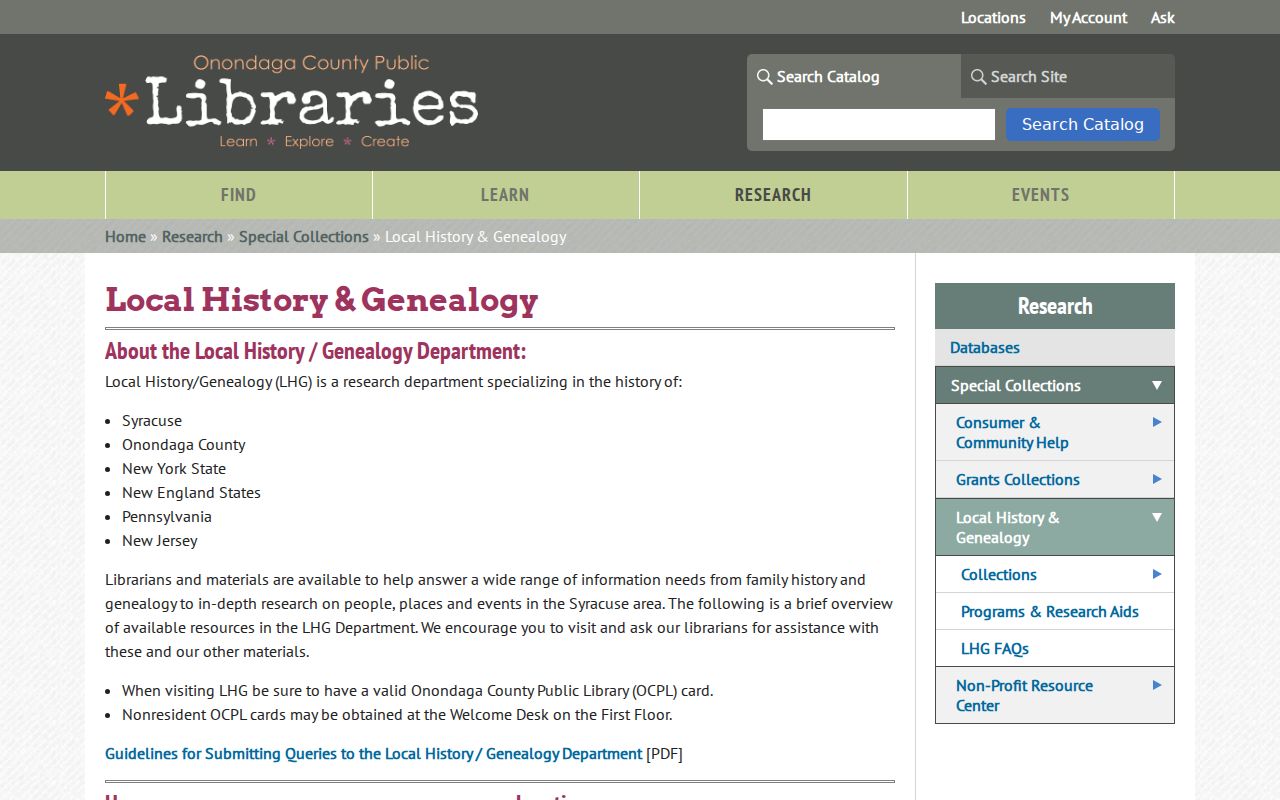
Use the room's collection description as a starting point, then preserve the volume year, reel or shelf reference, and page number with every Syracuse directory observation.
Reading Syracuse City Directory Entries
A printed entry should be read as a dated listing, not as an unqualified statement of residence. The research confirms that Syracuse scans have not yielded one verified sample page or a complete local abbreviation key. That means it is safer to inspect the introductory pages before treating a letter as an owner mark, a relationship label, or a move notation. A typical local entry may carry a surname and given name, initials, a household relation, work or business information, a street address, and a cross-reference. Some editions may add a separate business address, apartment or room information, widow notation, or an owner and renter mark.
| Name form | Copy initials, spacing, and every spelling variant instead of silently standardizing them. |
|---|---|
| Household clue | Record any spouse or relationship notation only as printed in that edition. |
| Work line | Note an occupation or business affiliation when the volume supplies one. |
| Address line | Capture the number, street form, apartment or room detail, and any separate business address. |
| Editorial mark | Photograph or transcribe the volume's key before assigning meaning to a one-letter abbreviation. |
- Criss-cross directory
- An address-first or street-first volume that can point from a location to a listed name, if staff identify one for that year.
- Householder index
- An index organized around the household head or address, when a volume includes one.
- Abbreviation key
- The editor's explanation of shortened terms, often in front matter, which should be checked before interpreting a listing.
OCPL confirms city and suburban directories and telephone books, but its accessible information does not establish a separate Syracuse criss-cross title or year run. Ask for a reverse directory, address directory, or suburban directory by year, then inspect nearby street pages rather than presuming the alphabetical book has an address section.
Syracuse Directory Name Paths
A normal Syracuse directory generally begins with a name and leads toward an address. A reverse or criss-cross volume reverses that path, starting with the street or number and leading toward a listed person. The distinction is crucial for family work around one address. If an address-first volume is unavailable, search the alphabetical pages for each name already connected to the address through a census, deed, newspaper, or map. Telephone books at OCPL run from 1894 to the present, with editions and gaps to verify. They may add a listed number or address for the era, but an unlisted number, a business listing, or an old listing makes them a limited companion rather than a full household count.
For a historical street form, preserve both the printed name and a modern candidate. Syracuse's 1887 renaming account includes changes such as Canal to Harbor, Exchange to Williams, and Hemlock to West Fayette. A map block, legal description, or adjacent street can settle whether two labels describe the same corridor. That check prevents a name search from jumping to a different Syracuse location.
Tracing Syracuse City Directory Families
A household trail is strongest when every observation keeps its own date. Directories can catch moves between federal census years, while New York State census microfilm at OCPL covers 1855 through 1925. Federal census records through 1950 are available under the 72-year release rule, and the 1890 federal census is largely lost. A disagreement between a directory and a census often reflects when each was compiled, so it should be recorded rather than forced into one answer.
- Establish the likely Syracuse address and municipality from a modern parcel or map record.
- Find the surname in the closest directory year, keeping every printed spelling, address, and work line.
- Move backward or forward one available edition at a time, checking former street names and number changes.
- Pair each key directory observation with the federal census or the New York State census microfilm year nearest it.
- Close a disappearance with an obituary index, deed, probate, naturalization record, cemetery card, or newspaper item where available.
When an issue is missing, do not fill the blank by inference. OCPL also holds newspaper clippings, family vertical files, WPA files, cemetery cards, and the Onondaga Pioneer Index for settlers before 1850. Those collections can supply a date, kinship clue, cemetery, former address, or name variant that reconnects the trail.
Syracuse Residents Beyond Directories
Directory research can become more personal when a household disappears from the annual listing. OCPL's multi-volume obituary index covers about 1860 through 1996. For later notices, its newspaper electronic resources and librarian assistance are the documented routes. Newspaper microfilm reaches from 1850 to within about three months of the present, although earlier coverage is incomplete. Census film, cemetery cards, WPA files, and local newspaper material offer useful checks for reunions, family history, heir research, and historical streetscape work. Each result needs a source, date, and role label so an obituary relative, map occupant, directory listing, and deed party do not become one unsupported identity.
The Onondaga Historical Association Explore collection describes more than one million items, including photographs, maps, newspapers, letters, postcards, and oral histories.
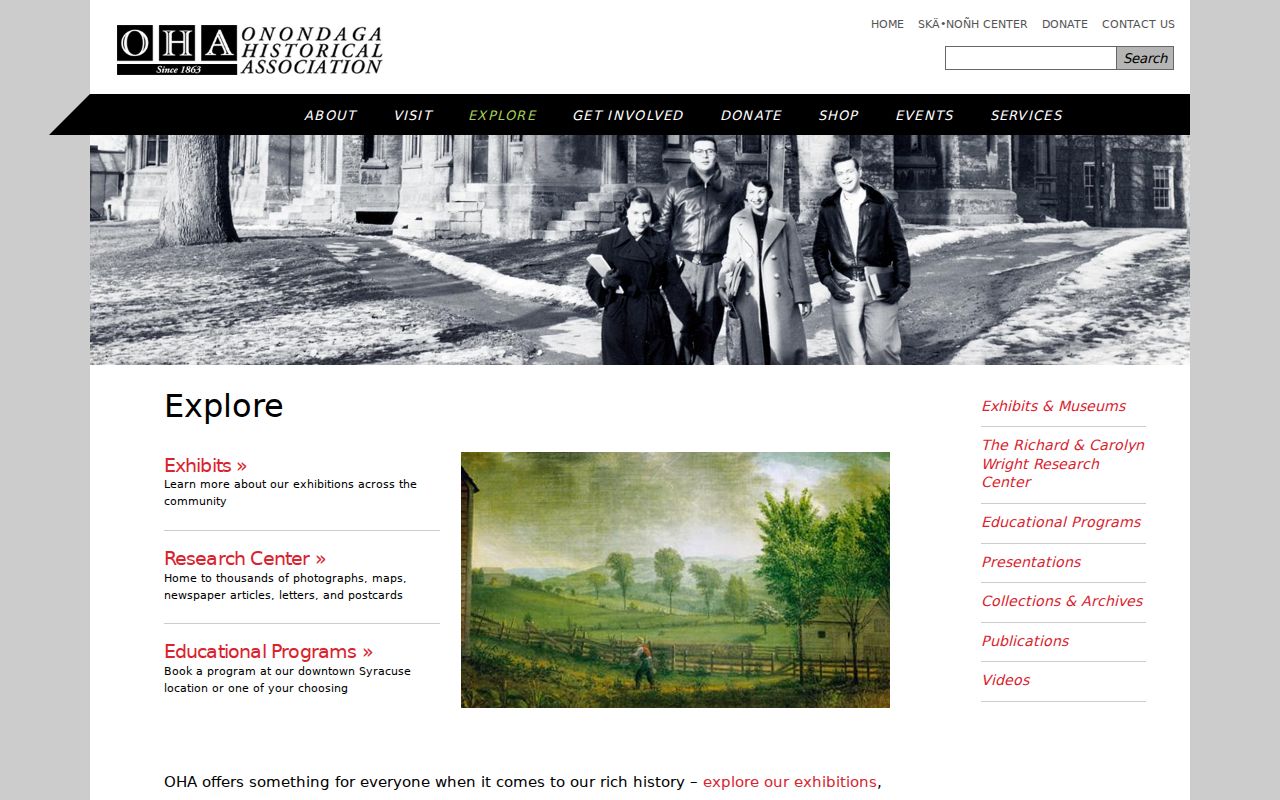
OHA's research center at 321 Montgomery Street is described as temporarily closed with an expected fall 2026 reopening, so check its current access instructions before planning a visit and use OCPL or NYSL as immediate alternatives.
Syracuse Map Occupant Clues
For a household that predates a usable directory, the 1852 Onondaga landownership map at the Library of Congress is an unusual bridge. Its metadata says the map shows buildings and occupant names and includes a Syracuse map with wards and block numbers. It can place a named person on a block before much of the surviving directory run. That is a geography clue, not final proof of ownership or residence, and it works best beside a dated directory, census, or deed.
Sanborn sheets add a different kind of context. The confirmed Syracuse 1892 volume has 78 sheets, while the 1953 volume has 59 sheets and includes portions of Solvay, Camillus, DeWitt, and Geddes. They can show a footprint, material, use, and street setting, but their city label may extend beyond the municipality being researched.
Syracuse Records Need Place Labels
Syracuse is the county seat, yet Onondaga County records span the city, towns, and villages. A mailing line or historical directory label can therefore describe a wider delivery and records setting. Keep municipality, situs address, mailing address, legal description, and ZIP as separate fields. The same caution applies to older geographic language. Canal and rail growth, the 1847 Syracuse and Salina merger, and city incorporation a year later all help explain why a record may speak in wards, villages, or nearby jurisdictions instead of today's familiar address form.
For a modern name confirmation after historical work, use a record that answers the specific question instead of treating the old listing as current proof. A Syracuse resident lookup can help keep a current-record check separate from the historical directory trail.
Syracuse Directory Access Limits
Several useful access limits remain visible. FamilySearch digitization through 1923 is reported by OCPL, but the exact Syracuse volume links and a page image were not verified in the research capture. Search the FamilySearch Catalog for the local directory title, then verify the volume, page, and any access requirement before relying on a scan. The State Library's materials are non-circulating and on-site. OCPL format ranges have missing years, and the exact local reverse-directory run remains unconfirmed.
Those limits are useful notes, not dead ends. Record the missing year, request help with a reel or catalog entry, and use the documented alternatives: County Clerk Archives, NYSL, newspaper microfilm, census film, maps, and archives staff. A clear source note makes the next Syracuse directory search easier to verify.